Mulmur 175
Visit our 175th Anniversary Store
We invite you to celebrate Mulmur's 175th Anniversary by ordering a shirt, sweater, or hat as we explore our local history, enjoy community events, and reconnect with neighbours and friends.
Purchase your 175 Swag Purchase 175 MUGS
 Support Local Stories: A Mulmur Mystery for Mulmur’s 175th Anniversary
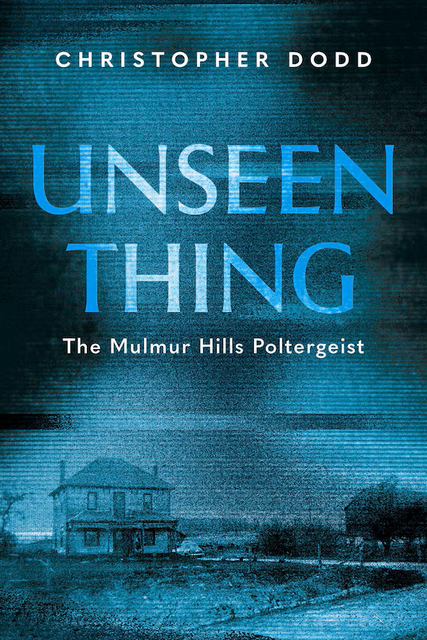
Written by local author Christopher Dodd, Unseen Thing: The Mulmur Hills Poltergeist is deeply connected to our local landscape and history. With the story rooted in the Mulmur Hills themselves, this book is a meaningful way to celebrate Mulmur’s 175th anniversary—honouring the stories, legends, and voices that make our community unique.
SELF-GUIDED 175 TOURS
Museum of Dufferin Mulmur 175 Driving Tour
Discover the stories behind Dufferin County with the Museum of Dufferin Driving Tour! This self-guided experience takes you through scenic landscapes, historic landmarks, and hidden gems that showcase our rich heritage. Whether you’re exploring charming villages or breathtaking countryside, the tour offers a unique way to connect with local history.. Grab your map, hit the road, and let the Museum of Dufferin guide your journey through time!
Dufferin Hi-Land Mulmur End-to End Challenge
Instructions: The Mulmur 175 End-to-End Challenge celebrates 175 years of Mulmur’s history, land, and community, one step at a time.
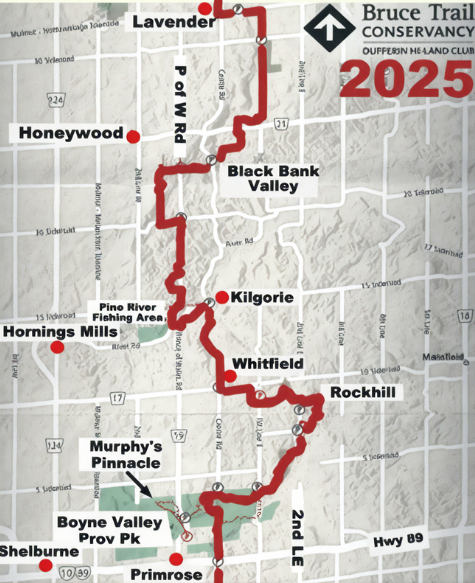
This 41.1 km journey follows the Dufferin Hi-Land section of the Bruce Trail, guiding hikers from Primrose to Lavender through some of Mulmur’s most scenic and storied landscapes. From rolling hills and hardwood forests to quiet country roads and escarpment views, the route reflects the deep connection between people and place that defines Mulmur. This challenge can be completed in sections or end-to-end. It’s your journey to experience at your own pace, whether you’re hiking solo, with friends, or as a family.
Challenge Details
- Open to all ages
- The challenge begins in Primrose and ends in Lavender
- All checkpoints must be completed on foot and on the assigned route
- Use the provided map to guide your journey
- The trail is divided into 13 official checkpoints
- At each checkpoint, you'll find a letter or number marker
- Collect all markers and unscramble the final secret message
Once completed, submit: - the secret message, and a few quick details (including the dates of your hike) to info@mulmur.ca to receive your Mulmur 175 commemorative memento.
About the Dufferin Hi-Land Bruce Trail Club
The Dufferin Hi-Land Bruce Trail Club is one of nine Bruce Trail Conservancy clubs responsible for maintaining, protecting, and stewarding the local section of the Bruce Trail through Mulmur and the surrounding area.
This challenge is offered in partnership with the Dufferin Hi-Land Bruce Trail Club, whose volunteers care for the trail year-round and help connect the community to this special landscape.
To learn more about guided hikes, volunteer opportunities, trail stewardship, and membership, visit the Dufferin Hi-Land Bruce Trail Club website:
Dufferin Hi-Land Bruce Trail
Trail Etiquette & Safety
- Follow official Bruce Trail signage at all times
- Pace yourself and take breaks as needed
- Watch for hazards such as uneven footing, slippery rocks, wildlife, and ticks
- Turn back if conditions require, safety first
- Respect the trail and community: pack out what you pack in
MULMUR MONDAYS - HISTORICAL FUN FACTS
In partnership with the Museum of Dufferin, we’re celebrating Mulmur’s 175th birthday by sharing fun facts, historic moments, and stunning architecture across our social channels! Join us every week for something new!
The First By-Law
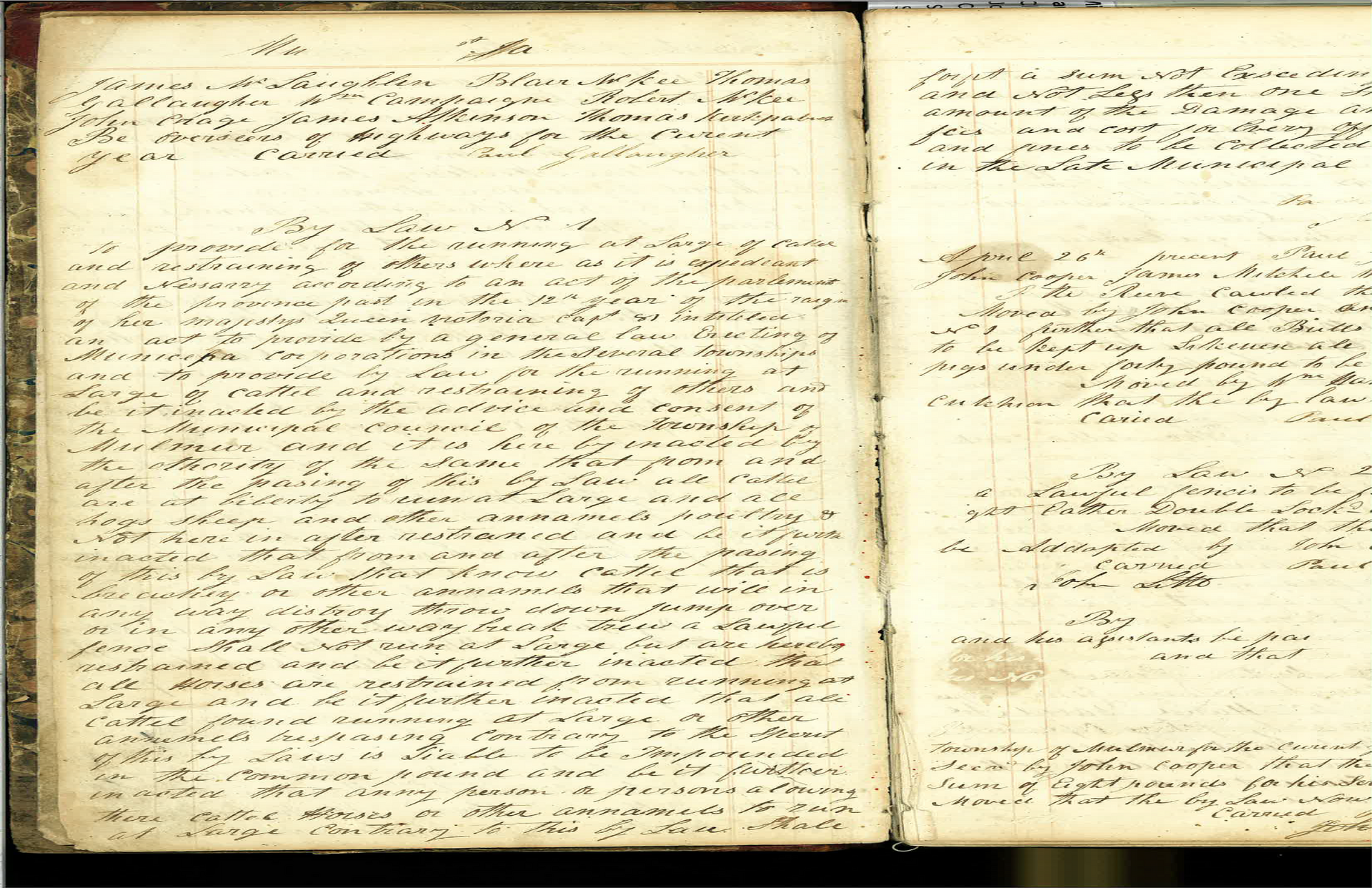
On January 1st Mulmur turned 175! The story of Mulmur begins in the early 1820’s when the Township was surveyed, and lands were granted to settlers. By the 1830’s, early settlements emerged, including Mulmur Corners, Whitfield, Mansfield, Stanton and later Honeywood in 1848. On January 1, 1851 Mulmur was officially incorporated as a municipality. The minutes of Mulmur’s first council meeting on January 21, 1851 capture a notable moment in our community’s beginnings. Present as the first members of Council, Reeve Paul Gallaugher, John Cooper, James Mitchell, William Hand and David McCutcheon appointed John Little to serve as the Township’s first clerk and treasurer, marking the formal establishment of local administration. Mulmur’s history is a story of resilience, vision, and community spirit transforming a rugged landscape of trails into a thriving rural municipality with schools, libraries, and essential services. Join us in 2026 as we celebrate Mulmur's 175th and highlight its history!
Photo: Minutes of the Mulmur Council First Meeting Photo Credit: Township of Mulmur
Mulmur turns 175 in 2026!
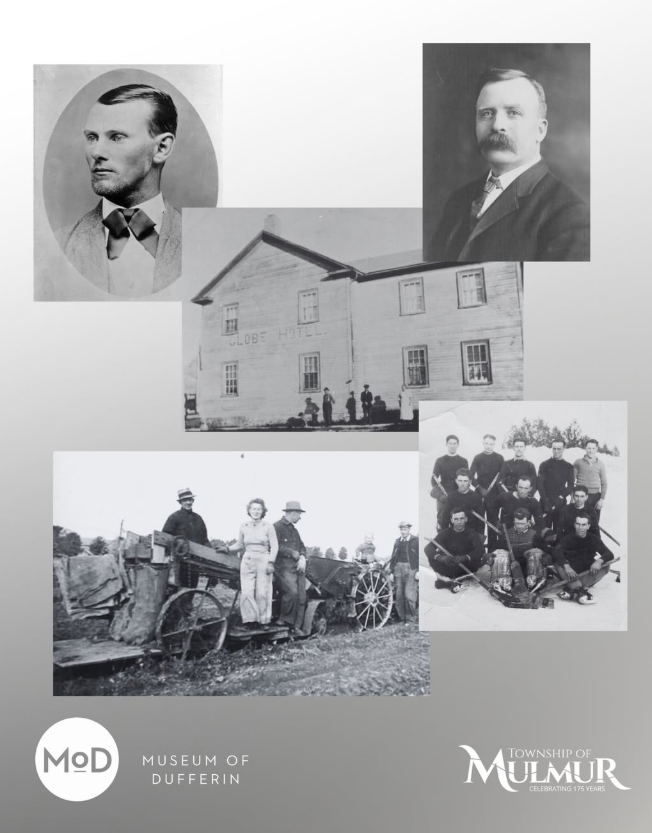
This isn't just any township...since it's incorporation in 1851, Mulmur's history has been rich with creativity, influence, a touch of legend - with a little mischief thrown in for good measure! From the inspiring to the infamous, the people who called Mulmur home shaped it into the place we know today. All year long, the Museum of Dufferin will be sharing stories of the people, towns, businesses and even buildings that make Mulmur so fascinating - and trust us, you won’t want to miss a single one
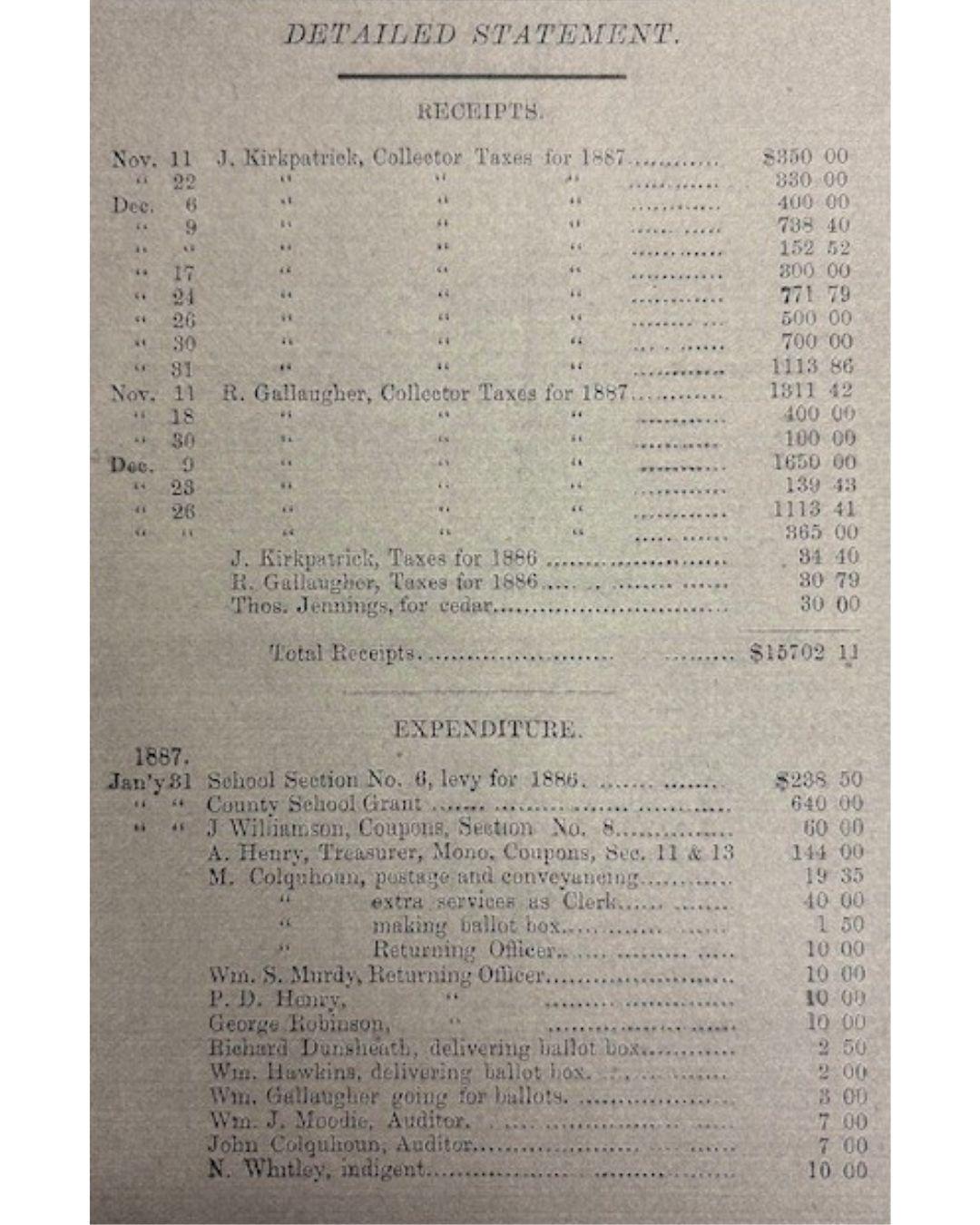
Early Taxes
Did you know that Mulmur’s very first tax by-law dates all the way back to 1851? By law No. 6 set the Township’s total taxation amount at forty pounds, six shillings, and nine pence—a foundational step in building the community we know today. From the very beginning, taxes played a vital role in supporting public services. In 1853, Council directed ½ penny on the pound of assessed property to purchase library books for the local school and later, $10 per school was provided to help buy maps. As Mulmur grew, so did its investments. In 1870, Council approved one of its largest expenditures to date—$300 to construct a bridge over the Boyne River on the Sixth Line (now Airport Road). This early infrastructure project supported travel, trade, and connection across the Township. Fast forward to today, and taxes continue to be a cornerstone of community building, helping to fund education, social services, police and fire, roads, recreation, and so much more. The legacy of responsible investment continues to shape the Township—just as it has for the last 175 years.
Photo: Excerpt from John A. Love’s Township of Mulmur Abstract and Detailed Statement of Accounts for the Year 1887 Photo Credit: Township of Mulmur
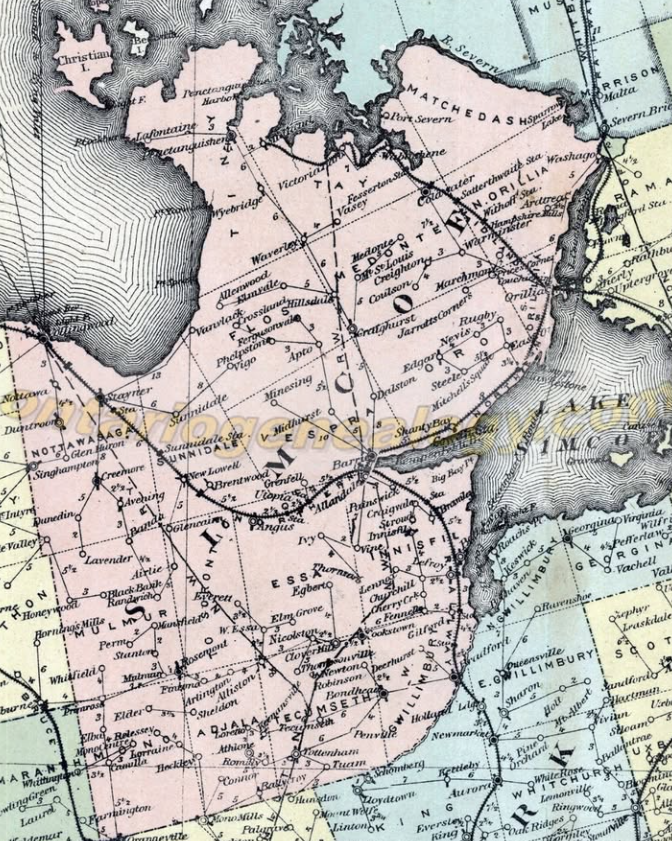
Simcoe County
Did you know… up until 1881, Mulmur was part of Simcoe County? The Baldwin Act of 1849 established the foundation of modern municipal government in Ontario. At that time, Mono and Mulmur were joined together for municipal purposes under a single council within Simcoe County. The partnership didn’t last long—after just one year, Mulmur withdrew, and on January 1, 1851, it was incorporated as its own municipality. Between 1869 and 1880, discussions began about reorganizing county boundaries, including proposals to divide Simcoe County into two or to create a new county from parts of Wellington, Grey, and Simcoe. This new county would eventually become Dufferin County. Although Mulmur supported remaining part of Simcoe, the Legislative Assembly ultimately included Mulmur in the formation of Dufferin County in January 1881. As part of this reorganization, Mulmur Township had to settle its share of Simcoe County’s assets and liabilities. To do so, it issued $20,000 in debentures at 6% interest, payable over 20 years. That would be over $600,000 today! The final payment was made in 1901.
Photo: A map of Simcoe County, ~1850 Photo Credit: Ontariogeneology.com
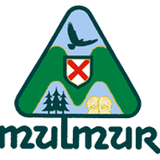
Mulmur's Crest
Mulmur's Crest - Designed by Janis Steinmanis, 1984 Designed by Janis Steinmanis in 1984, the Township’s Crest is shaped as an equilateral triangle, with the "L" of the Irish print in Mulmur forming a tree. The stylized green "M" represents the hills and valleys of our Township, with the blue part under the “M” representing the Township’s streams and small lakes. The fir trees represent the forests, and the stock of grain represents the main industry of agriculture. In the clear blue sky above the “M”, we see a hawk representing the wildlife of the Township. Photo: Township Crest Photo Credit: Township of Mulmur
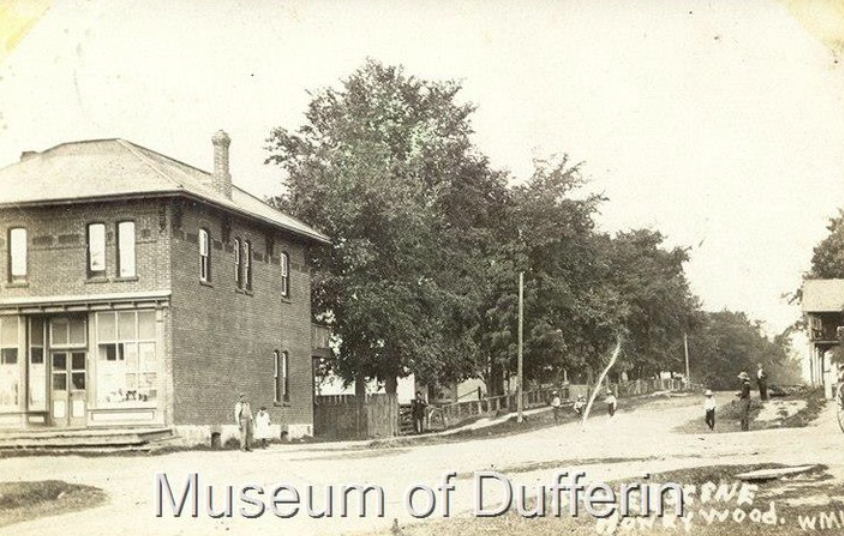
Honeywood
Originally known as the “Yorkshire Settlement”, much of Honeywood’s early growth can be traced to a group of young men from Yorkshire England, who in 1848, became dissatisfied with conditions in England and decided to seek opportunity in Canada. Before moving, they sent two men ahead to survey the area and choose affordable homesteads. The land they chose belonged to Mr. Wood of Toronto, who had received it as a militia grant. As the owner, he also had the right to name the settlement. According to local stories, he first tried blending his surname with his wife’s to create the name “Rosewood.” When he discovered that name was already in use elsewhere, he chose a “sweeter” alternative—combining “Wood” with “honey”—and thus Honeywood became the name of the settlement. The early settlers cleared dense forests to create rich farmland. Community life centred around an early log schoolhouse/church built in 1856 on what is now the grounds of the Honeywood Cemetery. Businesses flourished to include a post office, general store, a tailor, blacksmith, and more. Honeywood became known for its strong community spirit, with families like Broderick, Foster, Siddall, and Tupling tracing their roots back to its founding. Today, Honeywood remains a vibrant rural community, proud of its heritage and deeply connected to the pioneering families who shaped its history. Photo: Postcard, Honeywood Street Scene, Mulmur, 1909 Photo Credit: Museum of Dufferin - MoD # P-0138 A
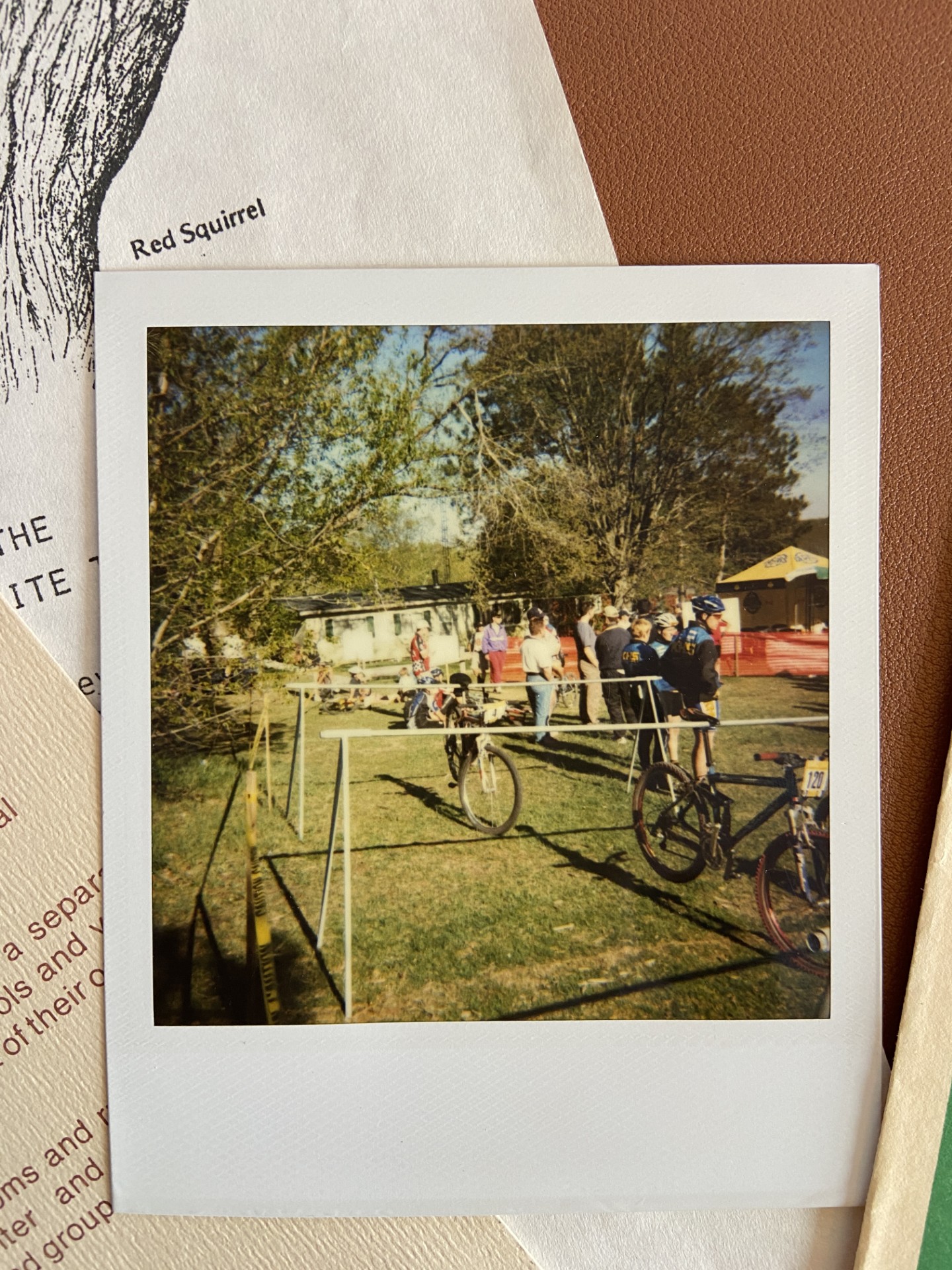
Mansfield Outdoor Centre
The Mansfield Outdoor Centre has been part of Mulmur’s landscape for more than a century — shaped by the people who lived, played, and gathered here. This story begins as a working farm, where the 1907 farmhouse — now the heart of our Main Lodge — once served as a family home. A glimpse of that era is captured in a photo from circa 1957, showing Boyd Gennings and his cousin Dennis sitting on the farmhouse steps, with the original barn standing proudly in the background. Over time, the porch and dining hall were thoughtfully built around the original structure, preserving its character while adapting to new uses. As the years passed, Mansfield naturally evolved into a place for outdoor recreation and community connection. Families spent summers camping at the trailer park, children played and cooled off outdoors, and athletes gathered for races and events. Printed brochures, hand-drawn illustrations, early logos, and candid photographs reflect a growing reputation as a destination rooted in nature and togetherness. In 1970, the property entered a new chapter as the Mansfield Forest Club, welcoming snowmobilers and outdoor enthusiasts. By 1974, Mansfield was home to some of Ontario’s first groomed cross-country ski trails, helping define its four-season identity. New ownership in 1983 officially established Mansfield Outdoor Centre, continuing a legacy of recreation, education, and stewardship of the land. Today, Mansfield Outdoor Centre remains a place where history and future meet — welcoming families, students, athletes, and visitors to gather, explore, and create new memories on land that has been loved for generations. A living piece of Mulmur’s history — still being written. Join us on February 16th at the Mansfield Outdoor Centre Family Day Winterfest as we celebrate Mulmur’s 175th Anniversary with family, neighbours and friends. Photos: Mansfield Outdoor Centre through the years
Photo Credit: Mansfield Outdoor Centre
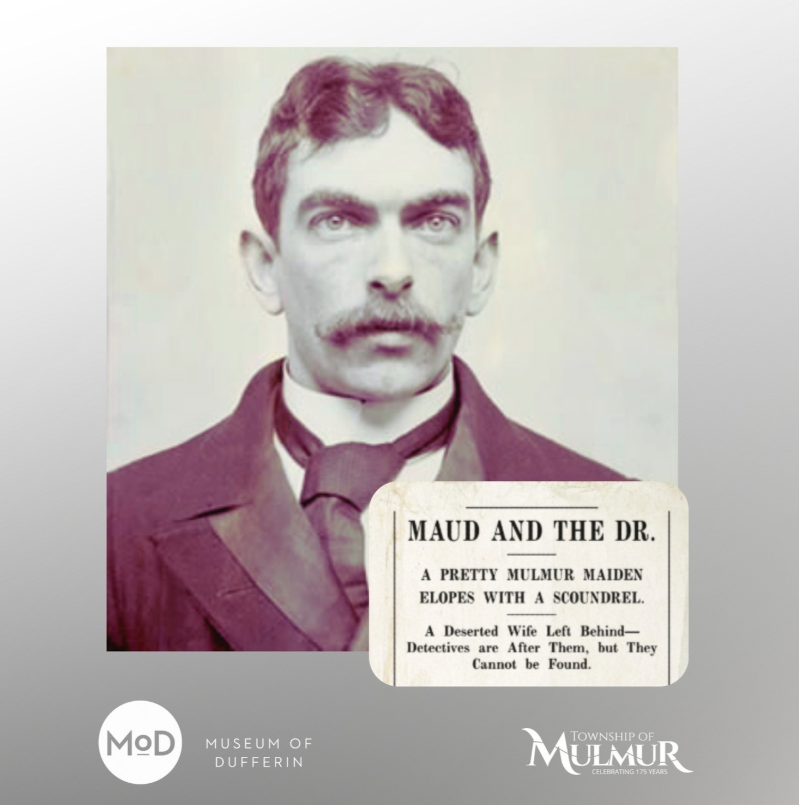
Andrew John Gibson
Did you know!? Mulmur Township was briefly home to Andrew John Gibson, one of the most well-known con men and bigamists of the 20th century! In 1897, a man calling himself Dr. Harry Westwood Cooper arrived in the community of Stanton. Polite, persuasive, and presenting himself as a medical professional, he quickly gained trust among locals. In reality, his real name was Andrew Gibson, and the impressive credentials were entirely false. While residing with a local family, he claimed to be in fragile health, and Maud Campaign was given the responsibility of looking after him. After a few weeks of courting the two snuck away to elope in Toronto. When the marriage turned out to be false, Maud returned to Stanton. Meanwhile, Dr. Cooper proceeded to San Francisco, then South Africa, England and Australia where he continued his string of cons and marriages.
Though his time in Mulmur was short, his story is a reminder that even rural townships could find themselves connected to international scandals and larger-than-life characters. The full story can be read in “The Love Pirate” in In the Hills Magazine.
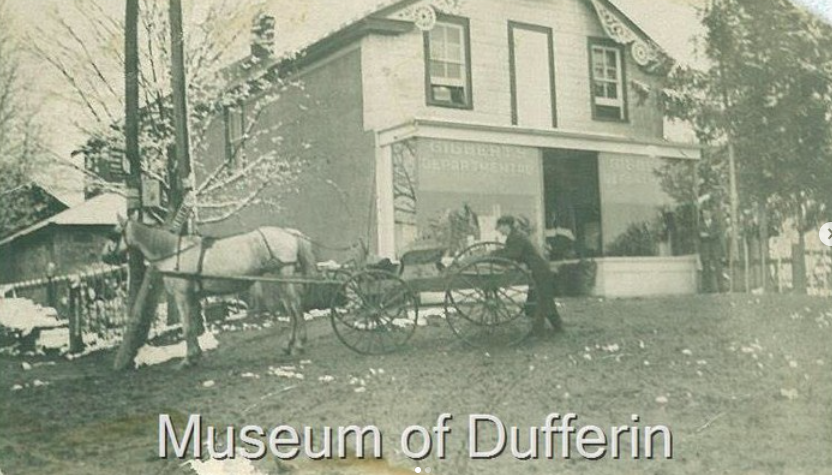
Gilbert's Department Store
Gilbert’s Department Store was a cornerstone of rural life in Mansfield. First established by Cornelius Beazer, the business was taken over in 1867 by William Gilbert, and later by his son, Hezekiah Gilbert. Under the Gilbert family, the store became much more than a place to shop—it grew into a true community hub. At various times, Gilbert’s housed the post office, operated as a hotel, and served as a central trading point for local residents. Settlers often exchanged eggs and produce for everyday necessities such as flour, sugar, and hardware, making the store an essential part of daily living in the area. What began as a traditional general store has since evolved into the modern brick and glass building that continues to serve Mansfield today. Gilbert’s legacy reflects the entrepreneurial spirit and social importance of rural merchants in Ontario’s history—a tradition of service, community connection, and local support that still shapes Mansfield’s identity. Photos: 1. Gilbert's General Store, Mansfield 1900 Image: MoD # P-3238 Museum of Dufferin
Whitfield
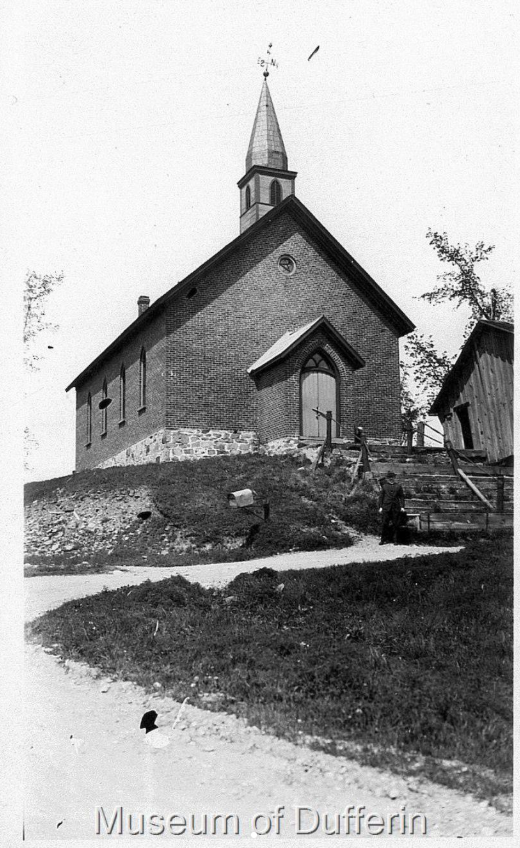
Whitfield—originally known as Beechnut Corners—emerged as a major settlement along Hurontario Street in the 1820s. Early village plans were prepared by Hugh Campbell and James Whitley (whom later gave the community its name). The Christ Church was built in 1874, with members of the congregation hauling the bricks all the way from Proton and contributing much of the labour themselves. The structure still stands today and is one of the earliest surviving pioneer buildings in Mulmur. In 1870, Whitfield School SS#4 was constructed at the corner of Lot 10 (present day Prince of Wales Road and 10 Sideroad). This building was later replaced by the brick schoolhouse that continues to stand as a visible reminder of Whitfield’s educational heritage. At its peak, Whitfield was a thriving settlement, home to stores, sawmills, blacksmith shops, a lime kiln, a school, churches, a post office, taverns, and an Orange Lodge. Today, Whitfield preserves much of this rich heritage through its historic church, former schoolhouse, and longstanding family farms—each contributing to the enduring legacy of one of Mulmur’s most vibrant early communities. Photo: Christ Church Anglican, Whitfield, Mulmur, 1954 MoD# P-3805-006-1 Museum of Dufferin
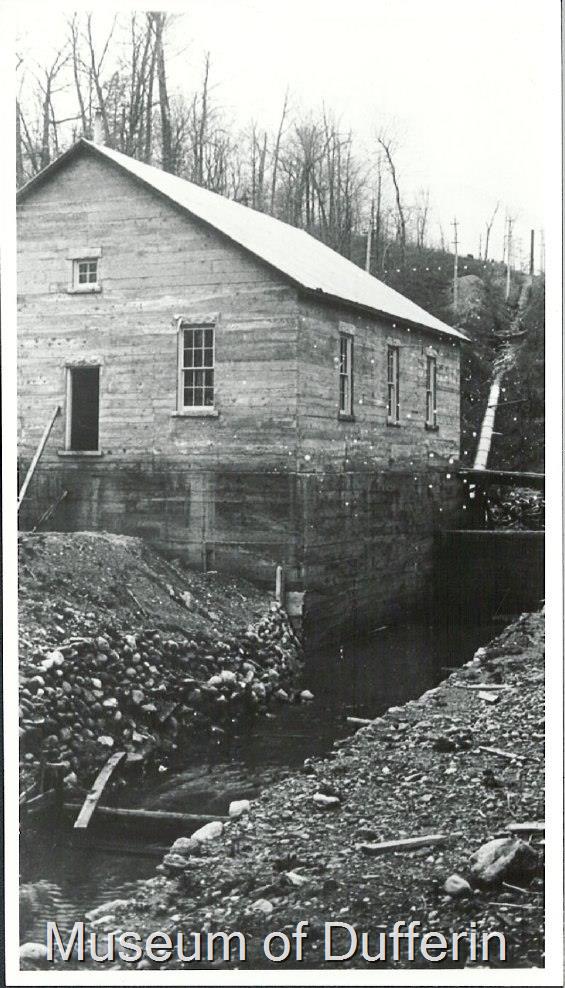
Dufferin Power and Light Company
Originally known as the Dufferin Power and Light Company, the Pine River Light and Power Company operated from 1908 to 1915 and was one of Ontario’s earliest private electricity providers. Founded by T.R. Huxtable of Horning’s Mills, the company supplied electricity when many rural areas still depended on candles and kerosene lamps.
The first powerhouse was built in Horning’s Mills, followed by a second dam and powerhouse in Mulmur around what is now the Pine River Provincial Fishing Area.
Between 1908 and 1909, the company successfully amalgamated with the Orangeville and Shelburne power plants and in 1908, the company received permission—at its own expense—to relocate sections of River Road and install poles and wiring to serve Shelburne, Horning’s Mills, and parts of Orangeville. Financial difficulties quickly arose however, and in 1911 the company was reorganized and renamed the Pine River Light and Power Company.
In 1915, the Hydro Electric Power Commission took over operations, issuing 20-year service contracts to Orangeville and Shelburne.
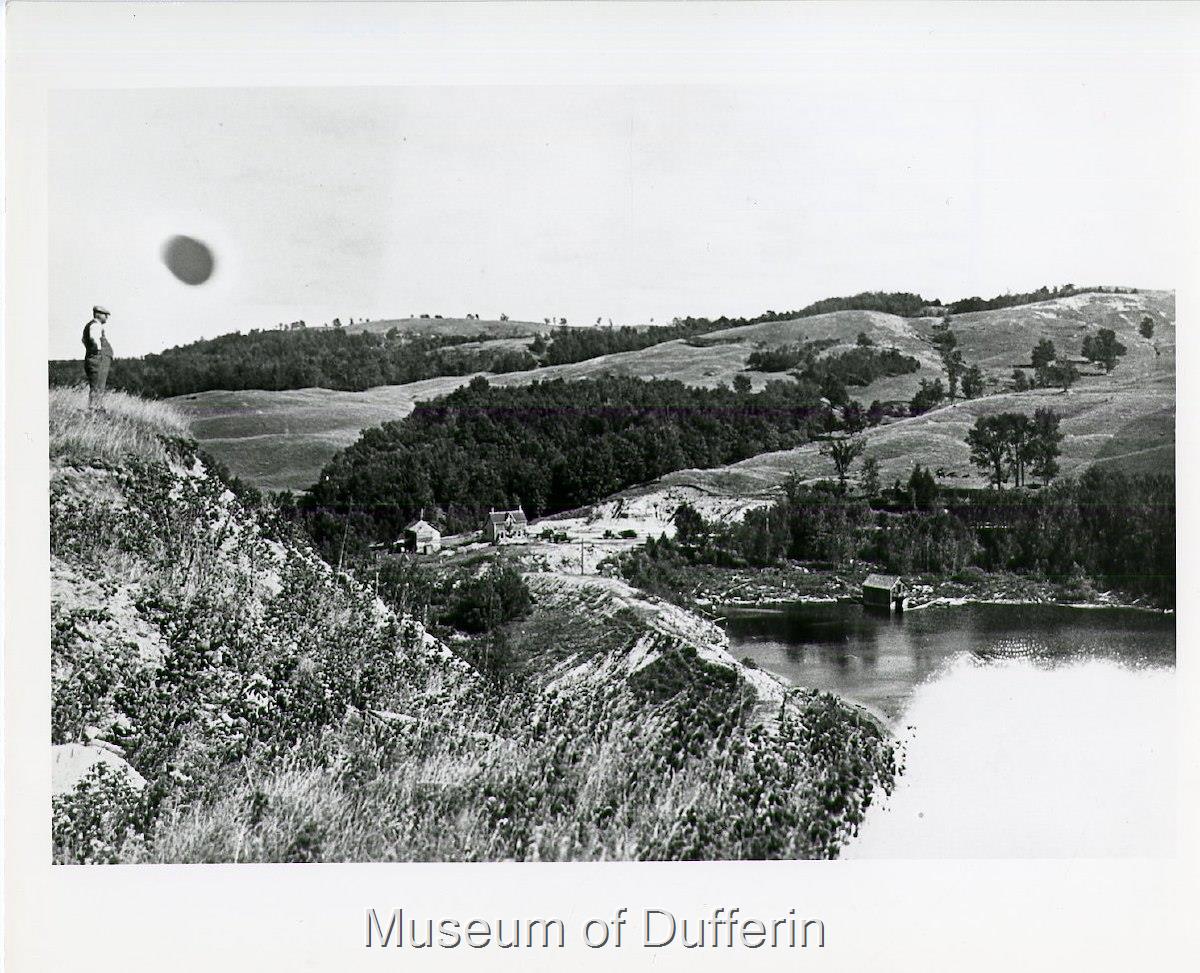
Although the company’s lifespan was short, Pine River Light and Power played a significant role in modernizing the region, marking the transition from traditional lighting methods to electric power and laying important groundwork for future development. Ruins of the Mulmur powerhouse can still be seen today along the Kilgorie section of the Bruce Trail. Photo: Pine River Light and Power Company 1911-1915 MoD # P-0242 Museum of Dufferin
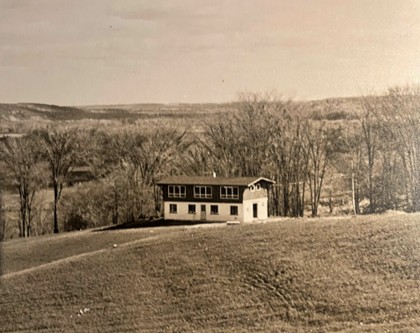
Mansfield Ski Club
What began as one man’s dream in the rolling hills of Mulmur has grown into one of Mulmur’s most beloved family ski destinations. Mansfield Ski Club, now home to nearly 500 families, traces its roots back to the passion and determination of founder John Low, whose love for skiing was sparked in his youth at a small club near Burlington.
Low envisioned a ski area closer to the city than Collingwood—and in 1961, he rallied a group of skiing enthusiasts to purchase 50 acres of Mulmur farmland. Together, they established what was then known as Mansfield Skiways.
The club officially opened on December 22, 1962, operating with a rental fleet of just 20 pairs of skis and a ski school staffed by only two instructors.
Ski racing arrived at Mansfield in 1968, and through the 1970s and early 1980s, the program supported 40–60 racers annually. Today, Mansfield’s racing program has expanded to include hundreds of athletes each season!
In 1983, a group of dedicated season pass holders purchased the ski area, establishing the Mansfield Ski Club. Today, Mansfield Ski Club boasts top-tier snowmaking, modern lifts, vibrant social events, and facilities designed with families in mind. Embracing everything the beautiful landscape of Mulmur has to offer, the Mansfield Ski Club remains proud of its humble beginnings and the legacy shaped by its founders more than six decades ago. Photo Credit: Mansfield Ski Club
Taverns and Hotels
In Mulmur’s early days, taverns played an essential role in community life. They offered shelter to settlers searching for land—many of whom travelled on foot or with a yoke of oxen—and also served as lively social hubs for the growing township.
The first tavern license in Mulmur was issued in 1856 and from that point forward, the number of taverns grew quickly, to include the Mansfield Hotel (Mansfield), Stanton Hotel (Stanton), Queen’s Hotel (Rosemont), Prince of Wales Hotel (Primrose), Farms Inn (Banda), Union Hotel (Stanton), Simcoe Hotel (Airlie), Lavender Hotel (Lavender) and the Mulmur Hotel (Mansfield).
After 1873, the number of taverns declined as rapidly as they had appeared. As farms were established and road conditions improved, the need for taverns diminished significantly. At the same time, a strong temperance movement emerged in Mulmur, reflecting a wider trend across Ontario in the late 19th century.
In January 1900, a by-law prohibiting the sale of all liquor in Mulmur was approved by the local electors and only two taverns remained in operation. Although the by-law was later quashed on appeal, it clearly reflected the strength of temperance sentiment in the township at the time.
In honour of our early Irish settlers – Happy St. Patrick’s Day!
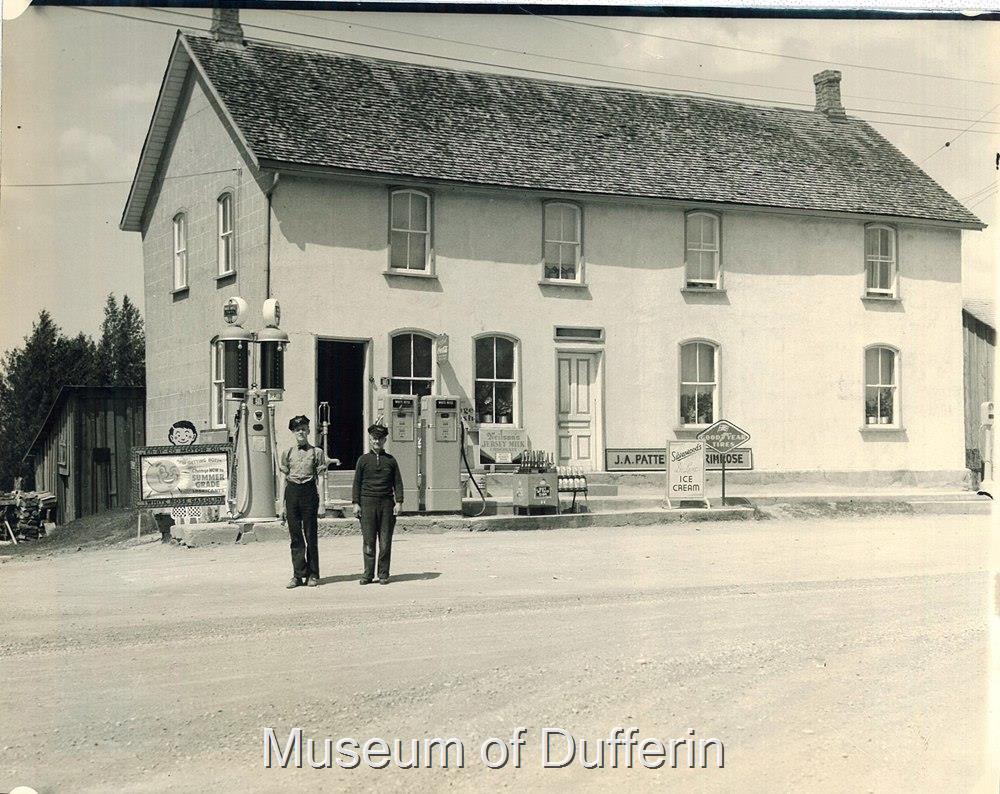
Photo: Patterson's White Rose Station ca. 1940 Primrose. John A "Jack" Patterson (1891-1956) and Mary "Alma" (Dean) Patterson (1899-1974) operated a gas, snack and variety business on the Northeast Corner, the current location of Champ Burger. The building was the former Dean's Hotel. Photo Credit: Museum of Dufferin - MoD #P-3774-006
Where did Mulmur get its name?
Although one theory suggests the Township was named after a son of the famous Shawnee Chief Tecumseh, the name Mulmur is most likely derived from the Irish Gaelic, Maol Mor or Maol Mòr, which translates to "many great bald hills" or "many rolling hills," fitting the Township’s landscape.
Now, 175 years later, we still proudly celebrate those very roots every time we say we live “In the Hills of Mulmur”.
Photo: Construction of the Pine River Light and Power Company (later the Pine River Fishing area), Mulmur, ca. 1915. Photo Credit: Museum of Dufferin MoD#P-7558 A
Violet Hill
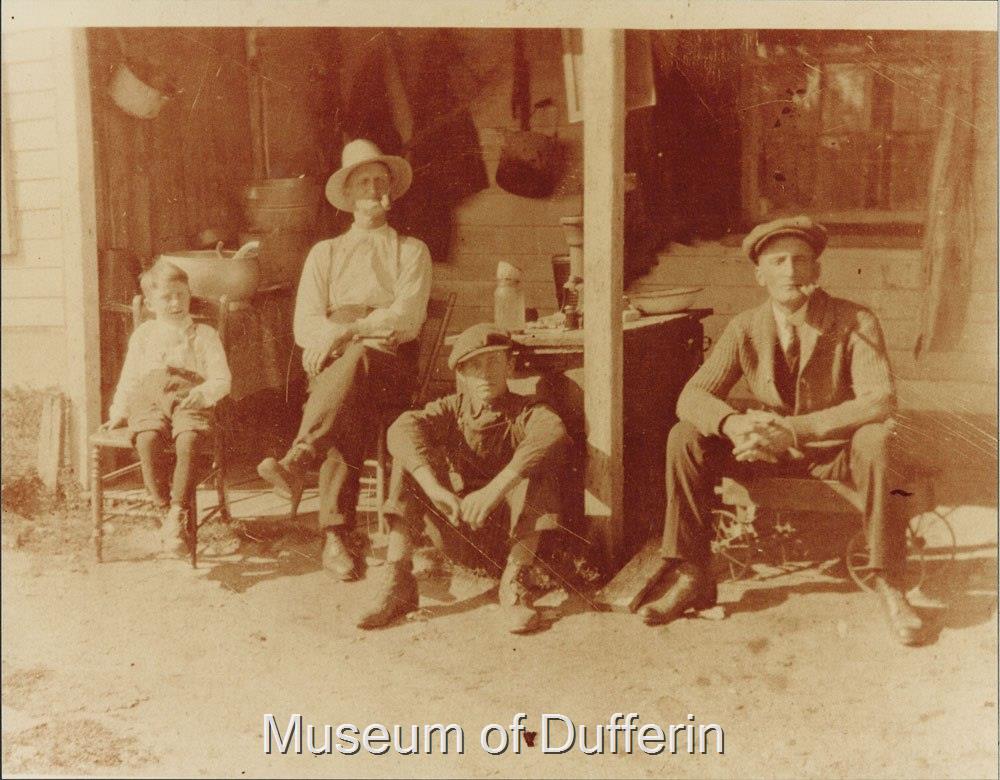
Violet Hill, founded in 1836, is one of Mulmur’s most historic communities. The first post office was opened in the home of Mr. and Mrs. Francis Robertson, and it is said that Mrs. Robertson named the office Violet Hill after the wild violets that bloomed on the surrounding hills.
By the 1870s, Violet Hill had grown into a bustling village with a Temperance Lodge, church, school, sawmill, blacksmith shop, library, and Orange Hall. It became a center for social life and community organizations, including the Women’s Institute (1911), the Good Templars—a men’s temperance group—and the Grangers, who promoted cooperative purchasing for the community.
Today, Violet Hill continues to embrace its rich heritage. Mrs. Mitchell’s Restaurant, opened in 1980 in the former Violet Hill SS #2 Schoolhouse, and Granny Taught Us How opened in 1978 in the old Orange Lodge, two examples of how history continues to live on in this charming hamlet.
Photos: 1. MoD#P-1927 - Mitchell Family on Porch, Violet Hill Mulmur, abt. 1921. Photo Credit: Museum of Dufferin
Maple Syrup
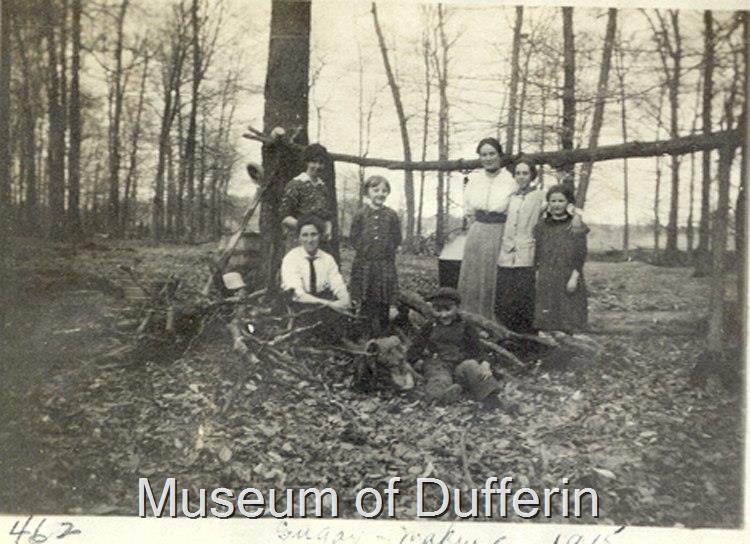
Early settlers depended heavily on the forest and the land for their survival. They cleared just enough land to build their homes out of the very timber they cut. Mulmur was no exception—with every farm functioning as a self-sufficient homestead, producing its own food, weaving cloth, and, of course, crafting sugar and maple syrup.
The story of maple syrup in Canada begins with Indigenous peoples, who first discovered and harvested the maple sap and later, shared these methods with the European settlers.
The first “sugar shacks” are said to have taken shape in the 1850’s - and today, maple syrup remains a beloved symbol of Canadian identity and is celebrated each spring.
Join us on April 11th from 10 am – 1 pm at Mulmur’s own 4M Maple (716092 1st Line East) as we celebrate Mulmur’s 175th anniversary, the rich history of maple syrup in our community, and the forests that have sustained settlers here for 175 years.
Photo: Maple Sugar Boiling on the McCutcheon Farm, Mulmur, ca. 1915 (MoD# P-0462) Photo Credit: Museum of Dufferin
National Siblings Day
This handmade papercut appliqué quilt was created by sisters Isabella and Jane Greer of Mulmur Township, Dufferin County, to mark Isabella’s marriage in 1888.
Isabella (1868–1942) and Jane (1854–1922), daughters of Mary and John Charlton Greer, were part of a large family with 10 other siblings. The sisters remained close their entire lives - eventually living together again after they were both widowed - making this quilt a lasting symbol of sibling connection and support.
Museum of Dufferin Collection, 968-14-01

Orange Lodge
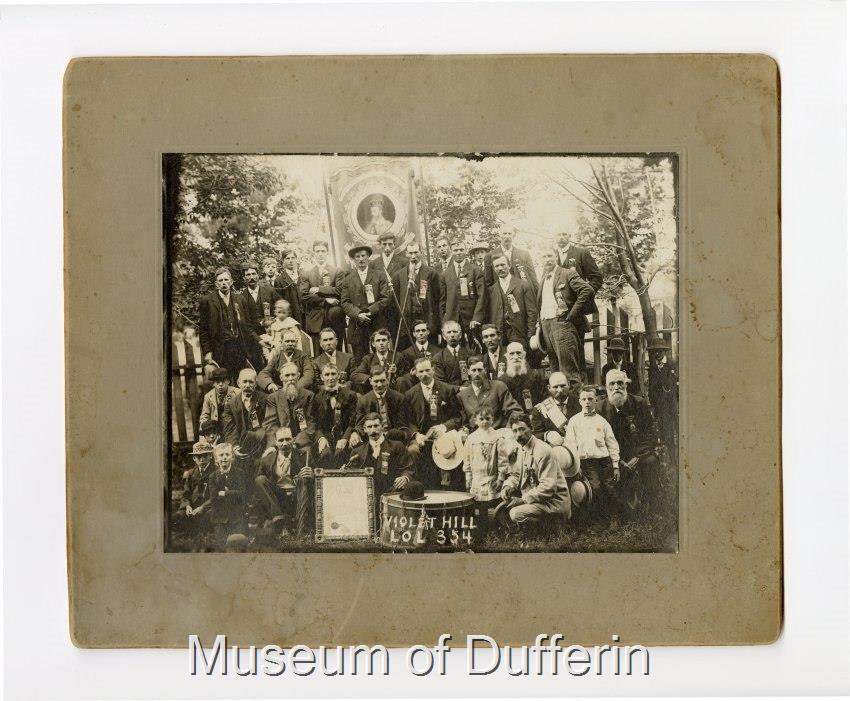
Any history of the Township of Mulmur would be incomplete without acknowledging the important role the Orange Order played in the community. Most of the early settlers came from Northern Ireland, bringing with them strong traditions of loyalty to the Crown and Constitution, along with the distinct Protestant values common in Northern Ireland.
It wasn’t long after the first settlers began clearing land in Mulmur that an Orange Lodge was established. In fact, many districts had Orange Lodges before they had churches.
The first lodge organized in Mulmur was Lodge No. 60 at Handsville (now Stanton). It received its original warrant in 1831, just one year after the founding of the Grand Orange Lodge of British America. Other early Orange Lodge’s include:
• Lodge No. 355 Perm, 1854
• Lodge No. 366 Whitfield, 1857
• Lodge No. 784 Mansfield, 1856
• Lodge No. 1082 Scarlet Hill, 1860
• Lodge No. 1246 Mount Pleasant, 1867
• Lodge No. 255 Randwick
• Lodge No. 1028 Banda, 1859
Orange Lodges served as central gathering places for the people of Mulmur, providing venues for elections and meetings while offering community support, social networks, mutual aid, and political influence—especially for Irish Protestant settlers.
Photo: Members of Violet Hill LOL 354, 1909 (MoD#P-0094) Photo Credit: Museum of Dufferin
Rock Hill Park
In 1940, 23 year old Elwood Hill inherited the family farm at the southwest corner of 10 Sideroad and First Line East in Mulmur. After marrying Jean Little in 1942, the young couple built a life farming and raising their growing family.
By 1958, their vision expanded beyond agriculture. After purchasing additional acreage, Elwood and Jean opened Rock Hill Park, a wooded family campground complete with swimming, picnicking, and recreation.
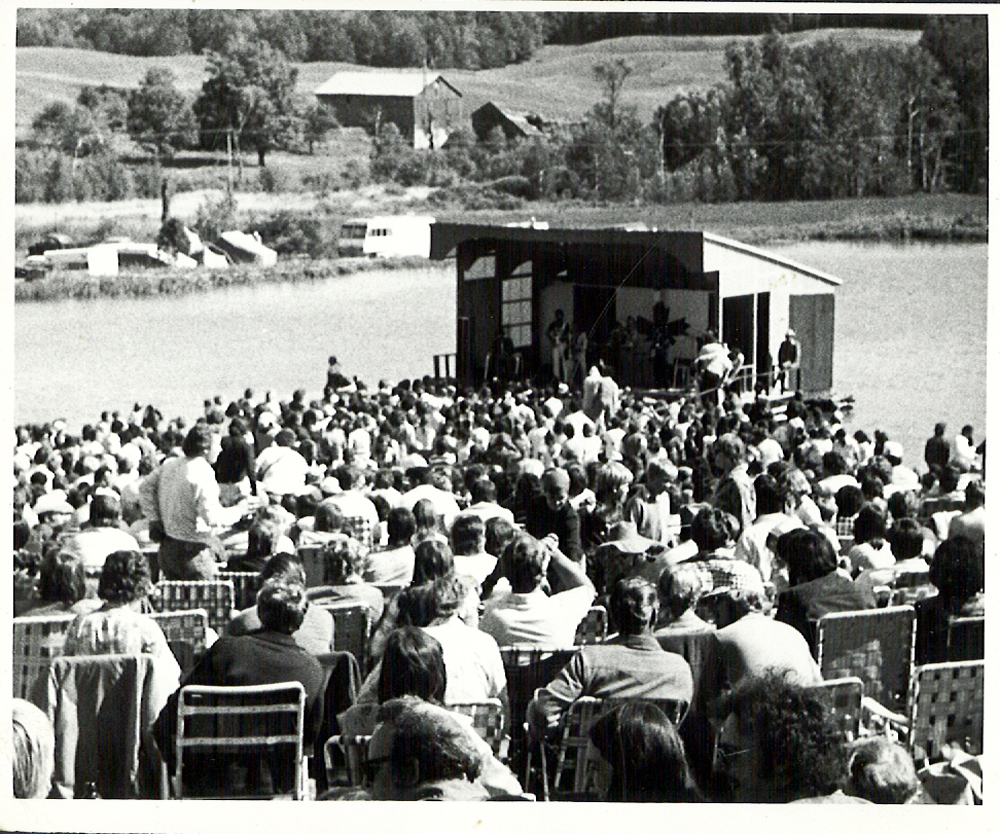
A year later, in 1959, they added Sunday night country music talent shows, which rapidly grew in popularity. Local performers soon shared the stage with rising Canadian artists, and in the 1960s, Rock Hill Park evolved into a bona fide music venue featuring country acts from Canada and Nashville.
In 1969 the music shifted from country to rock. That summer’s Freak Out Festival—a three day “camp in, swim in, paint in, dance in” extravaganza promoted by CHUM 1050—drew thousands. With artists like Lighthouse and The Guess Who, the festival put Rock Hill Park into the national spotlight.
Many locals found the festival too loud, too long, and too unconventional, and after repeat festivals in 1970 and 1971 tensions further escalated and resulted in a Supreme Court of Ontario injunction banning rock concerts and overnight festivals at Rock Hill Park.
Though the ruling ended the rock era, it pushed the Park back to its beloved country roots—leading to some of its most memorable Opry concerts and revitalizing the ever popular Sunday night shows.
Today Rock Hill Park continues to be a 65-acre Organic Potato Farm with 60 acres of private oasis for nature lovers, campers, hikers, and swimmers.
Photo: Crowd at Rock Hill Park Pavillion during Freddy Fender Concert, 1976 (MoD#P-2910-94) Photo Credit: Museum of Dufferin
Women's Institute (WI)
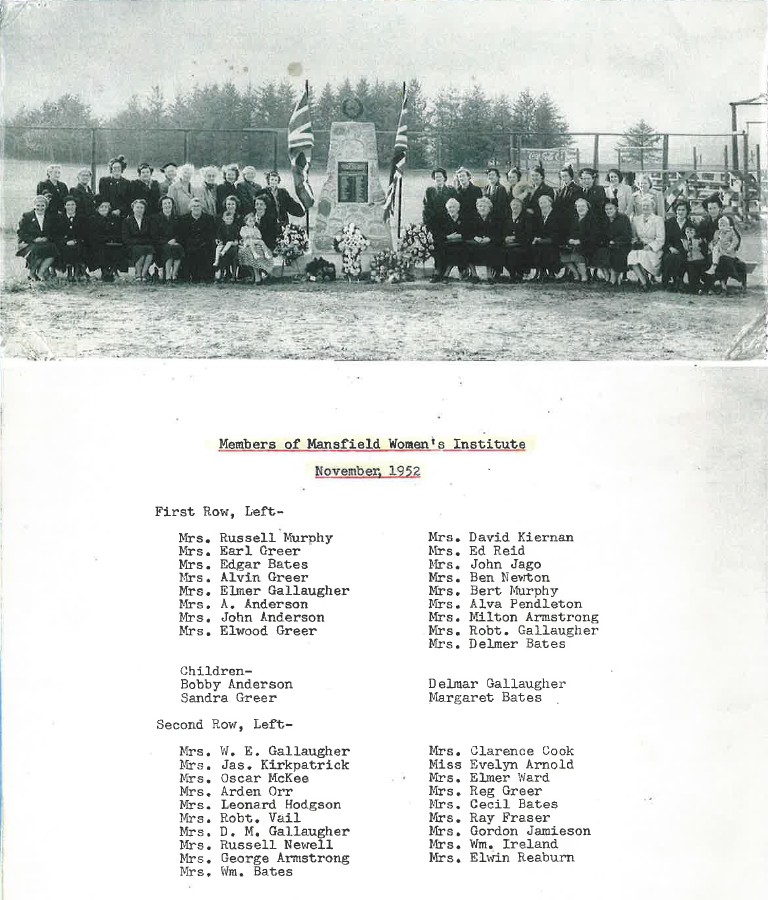
As Mulmur celebrates its 175th Anniversary, we proudly honour the lasting contributions of the Women’s Institutes (WI)—organizations that have supported and strengthened our rural community for more than a century.
Founded in 1897 by Adelaide Hoodless, the WI movement quickly grew across Canada, embracing their motto: “For Home and Country” and empowering rural women through education, community service, and leadership. Mulmur embraced this movement early, establishing several active branches over the years including:
• Honeywood (1904)
• Violet Hill - Mono & Mulmur (1911)
• Ruskview (1914)
• Kilgorie (1928)
• Whitfield (1944)
• Mansfield (1946) — still active today and celebrating 80 years in 2026!
In 1945, the WI launched one of its most beloved projects: the Tweedsmuir Histories—scrapbooks that preserved the stories of early settlers, family lineages, farming traditions, churches, schools, and the growth of our rural communities. These histories have earned national and international recognition for their importance in local heritage preservation.
Today, the Mansfield Women’s Institute continues its that proud legacy. Their contributions include organizing Mulmur’s annual Remembrance Day Ceremony, supporting the Museum of Dufferin, fundraising for local needs and building—and later restoring—the Mansfield Cenotaph.
To learn more, visit the Museum of Dufferin to explore Mulmur’s WI history, including Tweedsmuir collections and local archives.
Here’s to 80 years of the Mansfield WI and 175 years of community, connection, and the women who helped shape Mulmur. Photo: Mansfield WI November 1952 Photo Credit: Mansfield WI
Dufferin County Forest
This week, we shine a spotlight on one of Mulmur’s most significant natural legacies — the Dufferin County Forest.
In the late 1800s, Mulmur, like much of southern Ontario, saw widespread clearing of its vast pine, oak, and maple forests for land grants and farming. By 1900, most trees were gone and with no reforestation, lumber companies left, and the loss of tree cover led to severe soil erosion, making farming next to impossible.
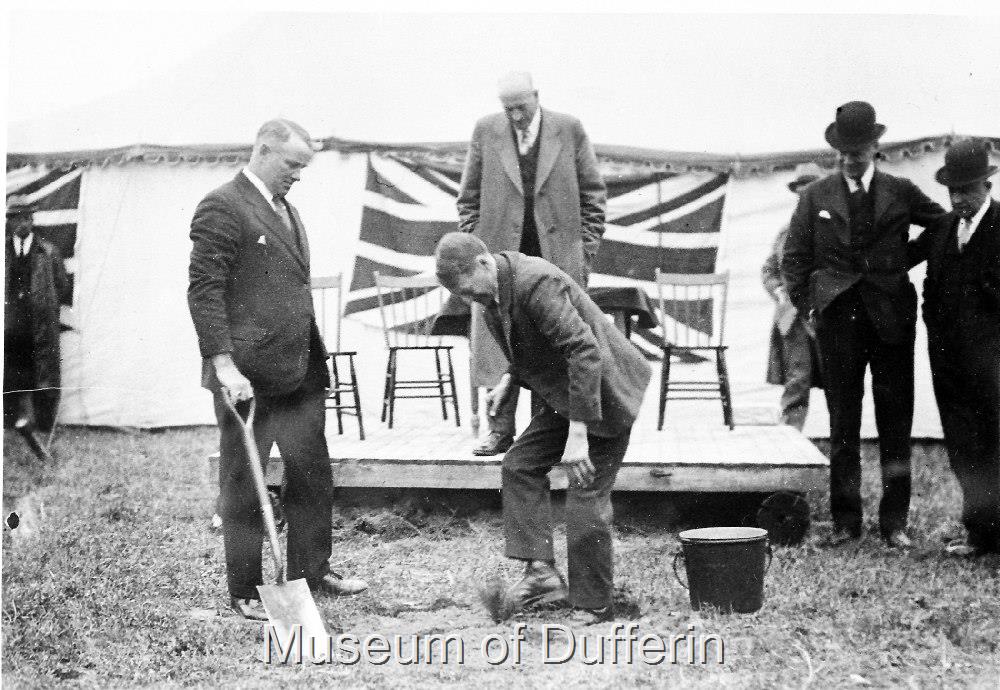
Recognizing this widespread issue, Ontario promoted reforestation as early as 1908. Dufferin began planting trees in 1905, eventually creating the Dufferin County Forest in 1930, when Dufferin County Council initiated the first land purchases right here in Mulmur. The first acquisition — over 1,000 acres on Concessions VII and VIII — became the foundation of what is now the Forest’s Main Tract. Over the next four decades, the County continued to acquire key properties in Mulmur, including what would later become the Little Tract, Simmons Tract, Thomson Tract, Leening Tract and Randwick Tract.
What began as a response to environmental crisis has now grown into a 1,066-hectare multi-tract forest system that protects natural heritage, supports wildlife, sequesters carbon, provides recreation, and sustains the rural economy through managed forestry.
Many of Mulmur’s forest tracts tell stories of early reforestation experiments, pioneer woodlots, and stands of white pine more than 150 years old, surviving the settler era. Today, careful stewardship continues under the County’s 2016–2036 management plan, ensuring these lands remain healthy and accessible for generations to come.
Explore Mulmur’s Forest Legacy! Whether you're hiking the interpretive trail at the Little Tract, biking the expansive network at the Main Tract, or discovering the unique plantings of the Simmons and Randwick Tracts, each stop offers a glimpse into Mulmur’s rich forestry heritage. Learn more: www.dufferincounty.ca/forest
Photo: First Tree, County Forest, Mulmur, 1931 (MoD#P-0346) Photo Credit: Museum of Dufferin
William “Squire” Campaigne
Today we honour one of Mulmur’s founding fathers - William “Squire” Campaigne, a respected pioneer whose influence helped lay the foundation of life in Mulmur.
Born in France around 1788, Squire Campaigne’s family left during the French Revolution travelling to Ireland, New York and finally settling in Mulmur on Lot 4, Concession 6. When he came to Mulmur is not known, but his grandson, William Campaigne of Mansfield, recalled hearing that his grandparents were married while they crossed the Atlantic.
Before formal municipal governments were introduced in rural Upper Canada, order and local decision making fell to magistrates appointed by the Lieutenant Governor. Squire Campaigne served as the magistrate of Mulmur, and is the predecessor of all the elected leaders who followed. He was the man to whom the people turned to, to settle their quarrels and disagreements, but also for advice and guidance.
On July 8, 1843, he was officially appointed Justice of the Peace, further cementing his role in overseeing the well being and development of the township.
Even after township councils were created in 1849 under the Baldwin Act, he remained actively involved, advocating for lawfulness and supporting essential infrastructure projects—including opening up the Sixth Line (now known as Airport Road).
Squire Campaigne passed away in 1859 and lies buried just north of the ruins of Old St. Luke's Church. His impact on our township lives on through both the history he helped shape and the generations of the Campaigne/Campaign family who continued to contribute to Mulmur’s story.
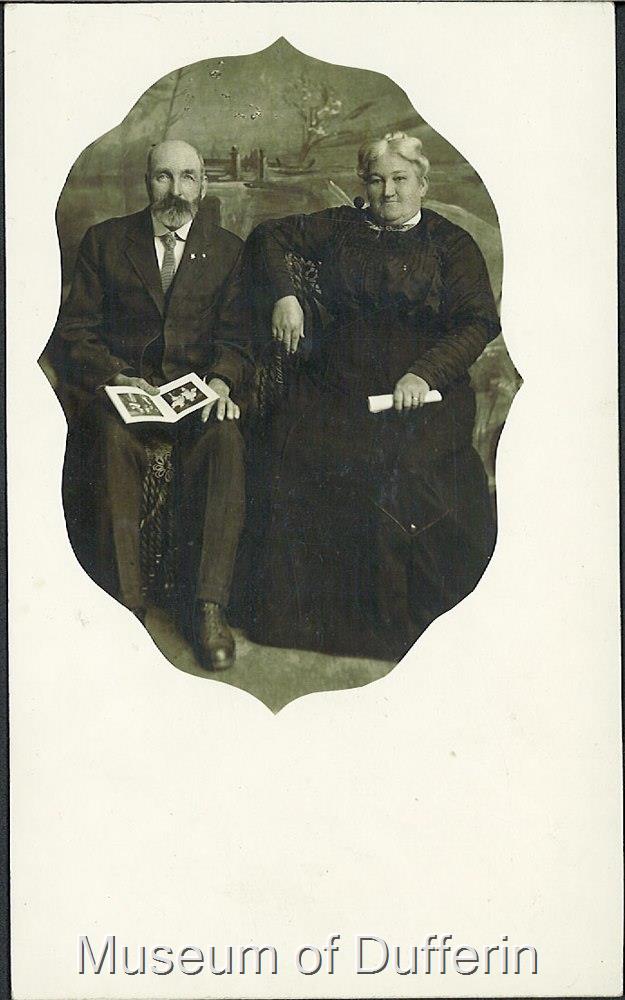
Historical Photos of the Campaigne Family: Photo 1. ca. 1900 Postcard of William (grandson of Squire Campaigne) and Elizabeth (McKee) Campaigne (MoD# P-1549 B) Photo Credit: Museum of Dufferin
Prince of Wales Road
In 1860 the Prince of Wales Road was completed from Orangeville to Primrose, closely followed by the opening of a general store in 1858, the Primrose Post Office in October 1860 and a hotel in 1873. Named for Edward, Prince of Wales (later King Edward VII) in honour of his visit with Queen Victoria, in 1860 this historic road further opened up the township to settlers.
From Primrose, the Prince of Wales Road was extended further north into Mulmur. Several schools and settlements popped up along this new road, including Ponton Mills - a dam and grist mill that was established in 1869 by George Shepherd and continued to operate into the early 1900’s.
In 1937 Mulmur purchased land in order to straighten out the deviation road, north of Primrose, and to enable the Township to build a bridge over the Boyne River. The bridge was opened in the late summer of 1937 with a gathering of officials and ratepayers.
Cherry Grove S.S. No.9, which still stands today at the corner of Prince of Wales and 5 Sideroad was originally located in the old Clokey house. A 40 x 30 frame schoolhouse was built in 1875. Followed by the more modern school you see today in 1926. The 1926 schoolhouse was a compact brick building, 25 x 30 in size and included a teacher’s room, library, two cloak rooms and a large basement.
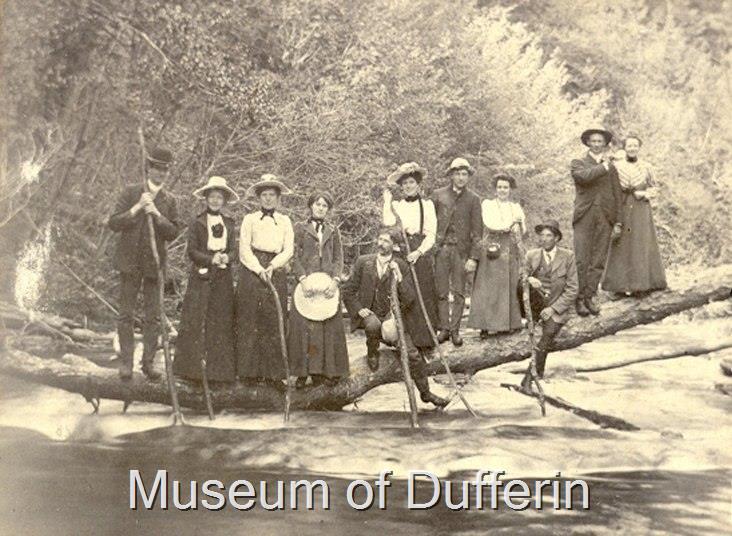
Photo: Group of people standing on a log overtop of the Boyne River near "Gatke's" Bridge, on Prince of Wales Road in Mulmur, date unknown (MoD#P-0447). Photo Credit: Museum of Dufferin
Randwick
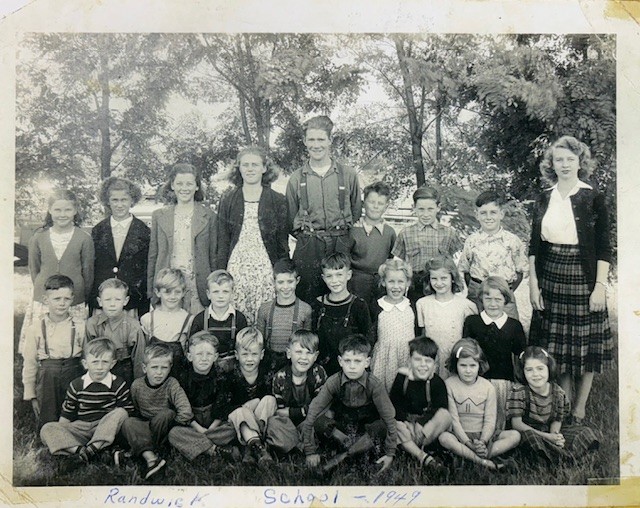
Located at the corner of County Road 21 and Airport Road, Randwick was originally the site of millworker's cottages for the surrounding sawmills. At its peak, Randwick had over 32 houses, a hotel, school (1865), a post office (1874), Orange Lodge No. 1028 and a church.
After a fire, the school was rebuilt and still stands today as a private residence.
When the lumber ran out, the mills and the people moved on. Over time, the land was reforested and became the Randwick Tract of the Dufferin County Forest, consisting almost entirely of red pine and white pine plantations and an extensive recreational trail system.
Randwick continues to be a familiar stop for residents and travellers. From Foxy’s to the Burger Bus and Ontario Honey Creations, it remains a small but meaningful part of Mulmur’s identity.
Photo: Randwick School SS#11 ca. 1949 (MoD#P-AR-1883-BB-02) Photo Credit: Museum of Dufferin
Bruce Trail
Did you know that one of the most breathtaking stretches of the Bruce Trail runs right through the heart of Mulmur?
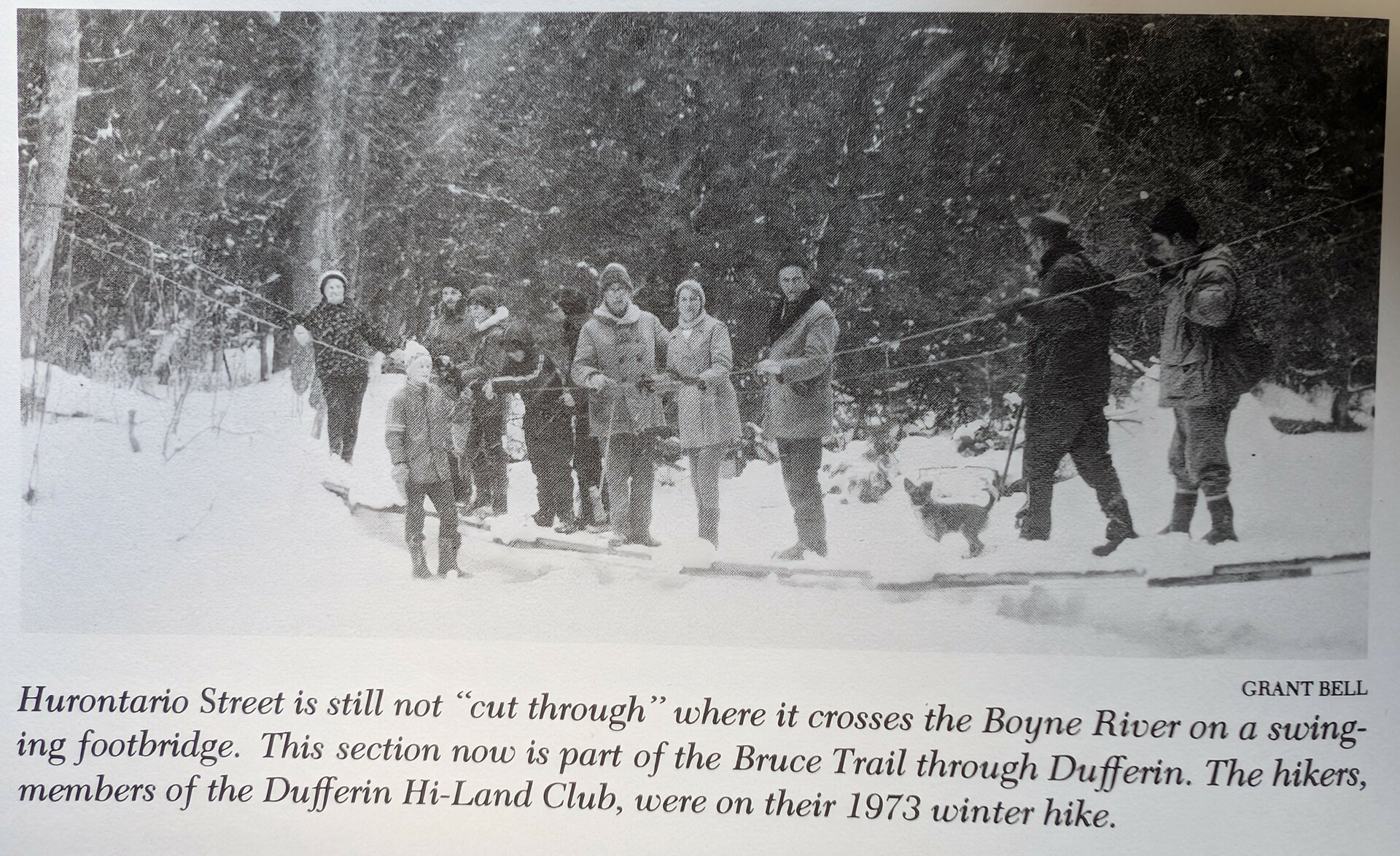
The Bruce Trail was established on March 13, 1963, with the goal of completing the trail for Canada’s Centennial in 1967. Local clubs were organized along the route and were given the job of marking the trail. The Dufferin Hi-land section was the 11th and last section of the trail to be completed. It spans 56.3 km and sits at the midpoint of Canada's oldest and longest marked footpaths. As the trail climbs north through the Mulmur Hills, it reaches elevations of over 1,650 feet above sea level, offering amazing views that have drawn people to this land for generations.
2025 marked 60 years of the Dufferin Hi-Land Bruce Trail Club, a legacy that is deeply rooted in Mulmur. In 1965, a small group of local leaders, including Ronald O’Reilly and Grace M. Bell, came together to complete a missing link in the Bruce Trail between Mono Centre and Mulmur and with the support of 32 landowners, their vision became reality.
Today, the trails run through the heart of Mulmur, across the Mulmur Hills, along the Pine River, and up to breathtaking escarpment lookouts. Stops like the Bell lookout, named in honour of early supporters, remind us of the people who shaped it.
Take a stroll and complete the Mulmur 175 End-to-End Challenge to earn your 175 Bruce Trail memento. This 41.1 km journey guides hikers from Primrose to Lavender. It’s your journey to experience at your own pace, whether you’re hiking solo, with friends, or as a family.
Photos: 1. 1973 Bruce Trail Photo Credit: Into the High County by Adelaide Leitch
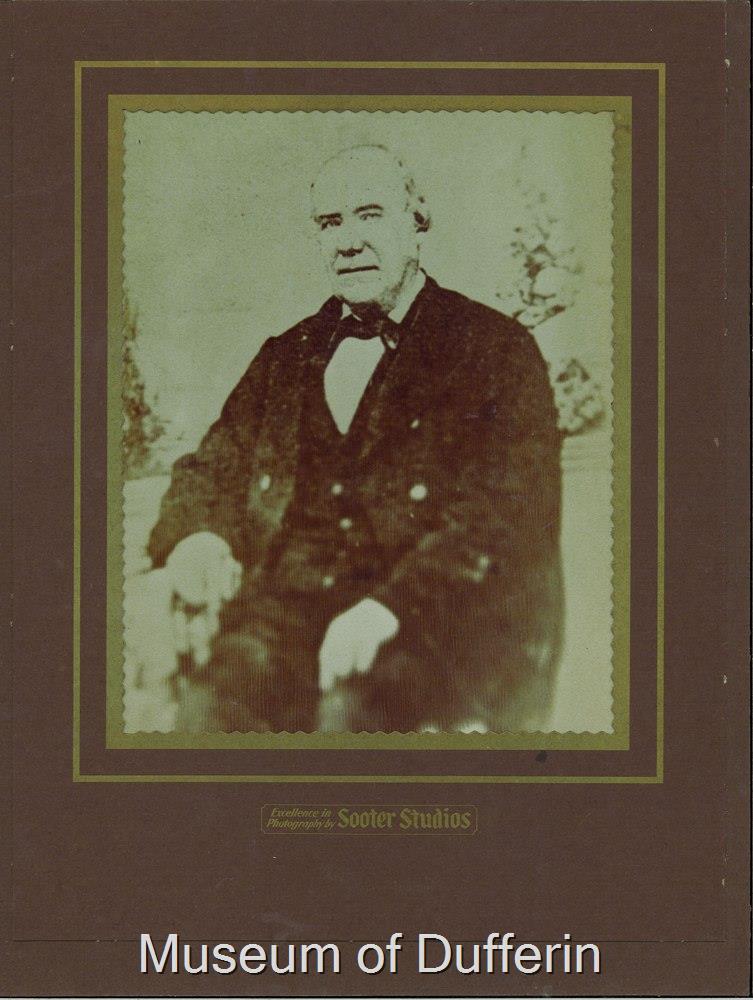
In Memory of John Little, Esquire. Born May 1st, 1802 – Died October 17, 1866
John Little Esq., one of the oldest and most respected settlers in the County of Simcoe, died at his residence in the Township of Mulmur, Ont., on the 17th day of October, A.D., 1866, in the 65th year of his age, lamented by a large circle of mourning friends and admitting acquaintances. As he was universally respected in life he is generally mourned in death.
Mr. Little was a native of Ireland, having been born in the Parish of Ematris, County Monaghan, on the 1st of May, 1802. In 1824, he emigrated to Canada, and soon after settled in Mulmur, where he was well known as the “Father of the Township”; a compliment which he richly merited by being its first Settler, its first Post Master, its first Clerk of Division Courts, and from having, at different periods, occupied the position of Township Treasurer and Reeve of the Municipality.
When he first entered Mulmur, nearly forty years ago, it was literally an untrodden wilderness, and the nearest settlement to the spot where he located himself was fifteen miles distant, and unapproachable except on foot.
He made his entrance into the Township with little property, save his axe; but he had a stout arm and willing mind for work, and soon hewed himself out a comfortable home and an independence.
He gradually but surely acquired a large amount of the great representative of wealth in Canada, and had the satisfaction of seeing his children and grandchildren located near him in the enjoyment of every reasonable comfort, and placed beyond the reach of such hardships as settlers in his early days had often to endure.
He had taken up his abode where the hear and the wolf had been hitherto undisturbed by the presence of man; but he lived to see around him one of the best settlements in the county, a thriving village close by, a near stone church on his own farm, and all the evidences of prosperity and civilization fast springing up and closing upon him. Like most of our first settlers, he loved to recall his early life in the bush, and although kindly and sociable in his disposition he would often wish to become once again the sole tenant of a wilderness. This feeling is, however, a very common one amongst the pioneers of the forest.
Mr. Little possessed many qualities which should keep him long in remembrance in his neighborhood. He was a good neighbor, a fast friend, and a strictly honest man. Many strangers and Missionaries who in days past visited the section of country in which he lived can testify to the hospitality which he and his excellent wife were always willing to extend to the wayfarer. He was a devout Christian, and a member of the Episcopal Church.
“The bad man’s death is horror; but the just keeps something of his glory in his dust.”
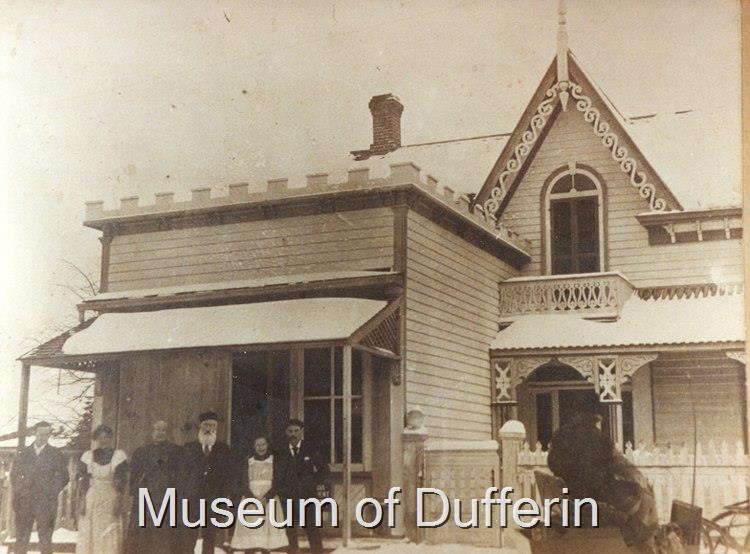
Photos: 1. John Little ca 1860 (MoD#P-1469). Photo Credit: Museum of Dufferin
Stanton
Stanton was Mulmur’s second settlement after Mulmur Corners. Although the first land was acquired at its crossroads in the 1820s, it took a while before the village was formed. The village grew quickly to include a post office (1867), a general store, 2 hotels, a courthouse, school, orange lodge (No.60) and more.
Did you know??
- SS No. 1, the first school in Mulmur was erected in Stanton. While its original construction date is unknown, the school moved locations several times before settling at its present site in 1868. This school still stands today as a private residence.
- The original general store still stands today on the southeast corner of Airport Road and 5 Sideroad.
- How did Stanton get its name? Two early settler families felt the village should be named after them, as the founding families. The Hand family wanted to name it "Handville". The Walkers felt it should be named "Walkerville". A judge stepped in to keep the peace and named the village Stanton.
Photos: 1. Love Family, Stanton General Store and Post Office, 1902 (MoD#P-0291). Photo Credit: Museum of Dufferin